HOTLINE: 0908 340 239
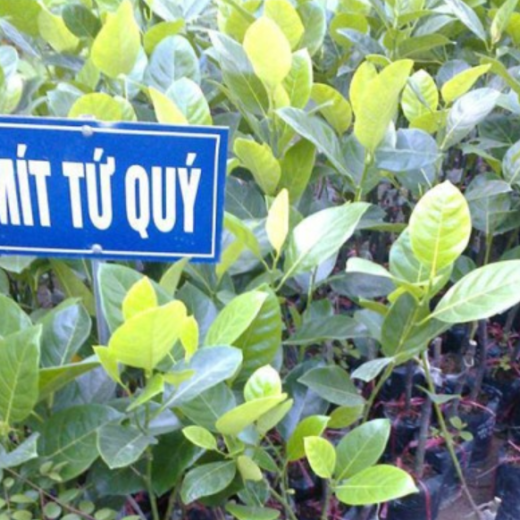
Planting Season: Early rainy season from May to July (solar calendar). If irrigation is proactive, planting can be done earlier or even year-round.
Dense Planting: Distance between trees is 5m, rows are 6m apart. Approximately 300 trees per hectare (to allow space for internal pathways).
Sparse Planting: Distance between trees is 6m, rows are 7m apart. Approximately 210 trees per hectare.
Guidelines: Infertile soil requires dense planting, while fertile soil suits sparse planting. Currently, there is a trend toward dense planting to increase yields and shorten the capital recovery period, followed by pruning techniques later.
Flat Land: Dig drainage trenches at least 30 – 40 cm deep (depending on the local water table) to prevent waterlogging during the rainy season. Dig holes measuring 40 x 40 x 40 cm and build mounds 40 – 70 cm high.
Sloping Land (approx. 5% slope): Mounds are not required; simply dig holes measuring 40 x 40 x 40 cm.
Steeper Land (slope over 7%): Dig holes measuring 40 x 40 cm and 60 cm deep.
Basal Fertilization Mix per Hole: 0.5 kg agricultural lime, 1–3 kg Better HG01 organic fertilizer (3-2-2). For standard 50 x 50 x 50 cm pits, separate topsoil and subsoil. Mix the topsoil with 10–12 kg of well-rotted manure (or 1 kg Komix organic fertilizer), 150–250 g Superphosphate, 50 g Basudin 10H (to prevent termites and ants), and 0.5 kg lime (to raise soil pH). Note: Uncomposted organic fertilizer or wood ash should not be used as basal fertilizer as they cause root rot and soil salinity.
Apply 10–12 kg of well-rotted manure (or 1 kg Komix organic fertilizer) and 150–250 g Superphosphate per hole, mixed thoroughly with surrounding topsoil.
Mix in 50 g Basudin 10H and 0.5 kg lime to prevent pests and improve soil pH. Avoid uncomposted organic matter and wood ash to prevent root rot and salinization.
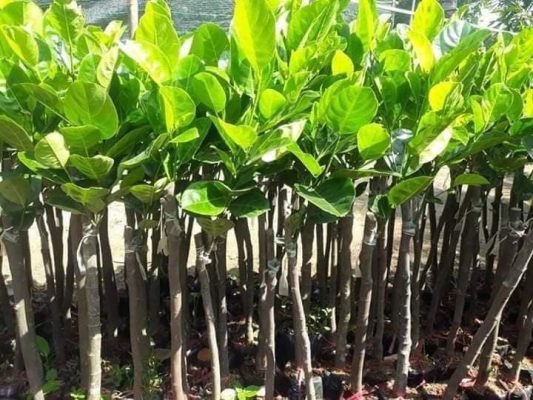
Use your hand to dig a small hole in the center of the planting pit slightly deeper than the nursery bag (about 2–3 cm) and slightly wider than the root ball.
Place the bagged plant on the ground, use a sharp knife to cut a circle around the nilon bag 2–3 cm from the bottom, and remove the bottom.
Inspect the root system, trim any rootbound or circling taproots/lateral roots extending past the soil ball, place it into the pit, backfill, and pull away the remaining nilon sleeve.
Firmly pack the soil around the base to prevent the young tree from swaying in the wind. Ensure the root collar is level with the surrounding soil (do not plant too deep or bury the stem).
Create a basin with a diameter of about 1 m around the tree to retain irrigation water.
Drive a stake next to the plant and loosely tie the trunk with nilon string to protect against wind. If planting during the rainy season, shading is not required like it is for durian or mangosteen.
Irrigation: Provide adequate water, especially during the dry season, fruit enlargement stages, and right before ripening.
Weed Control: Mulch the base with straw, green manure, or plant residues. Break soil crusts after heavy rains. Weed thoroughly during spring (January–February) and autumn (August–September), turning the soil 2–3 times a year.
Begin training and pruning once the tree reaches about 1m in height. Prune 2–3 times a year before the tree bears fruit, and once a year right after harvesting once it enters production.
Remove low-hanging branches near the ground, water sprouts, poorly positioned branches, and diseased limbs.
Retain primary branches starting from about 40 cm above the ground, spreading in different directions, spaced 40–50 cm apart vertically, keeping a maximum of 5 primary branches per tier. Thin out secondary and tertiary branches to ensure an open canopy for pest control and high productivity.
Year 1: Apply 100–150 g NPK (15:15:15) per tree every 1–1.5 months. Spray micro-element foliar fertilizers like Number One or Fetrilon-combi as directed to support nutrition while root systems establish.
Year 2: Apply 1.5–2.0 kg NPK fertilizer per tree at a 2:1:2 ratio.
Year 3: Trees enter commercial production; increase fertilizer by 0.5–1.0 kg/tree compared to the previous year, split into two applications at the start and end of the rainy season. During peak fruit sizing, apply potassium sulfate ($K_2SO_4$) at 400–500 g per tree, combined with 0-52-34 or 10-52-17 foliar spray 2–3 times (1 week apart) to concentrate ripening, enhance bright yellow flesh color, and improve flavor.
Stem and Branch Borers (Margronia): Adults lay eggs on young leaves and fruit, which then bore into branches. Spray insecticides during young leaf and fruit stages (e.g., Cyperan 5EC/10EC, Decis 2.5EC, Bian 40-50EC, Basudin 50EC).
Fruit Flies (Dacus sp.): Lay eggs in mature fruit, causing rot. Use biological attractants to trap males, bag fruits, or spray insecticides like Trebon 10ND, Decis 25EC.
Fruit Borers: Severely impact yield and quality, especially where fruits touch each other or the trunk. Prioritize biological controls or fruit bagging after natural fruit drop.
Fruit-Piercing Moths: Feed on ripe fruit at night. Control methods are similar to fruit borers.
Mealybugs and Aphids: Sap-sucking pests attacking young leaves, shoots, and fruit, causing curling, stunted growth, deformed fruit, and sooty mold. Spray with Bassan 50EC, Supracide 40EC, or Basudin 50EC when infestations exceed threshold levels.
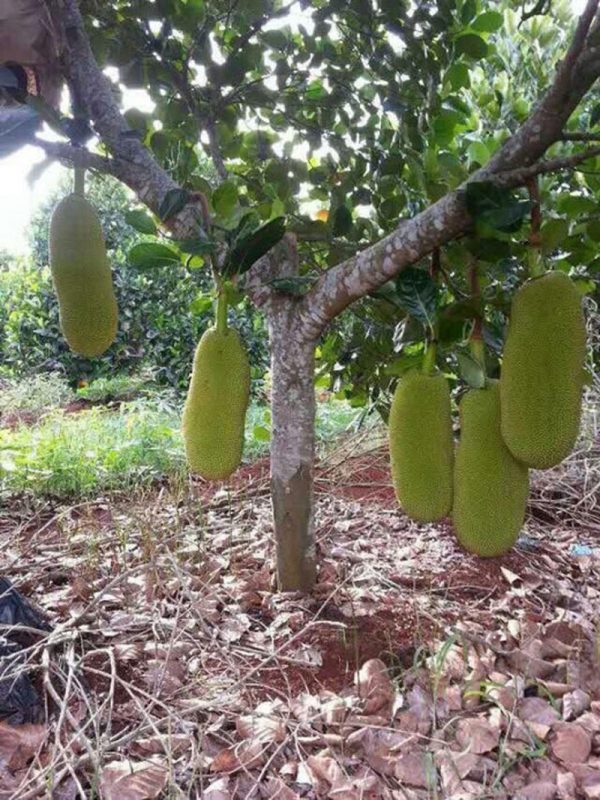
Jackfruit bears fruit year-round, but the main season in Dong Nai is June and July. The cycle from flowering to maturity takes about 5 months. Maturity is judged by skin indicators: fruit is mature when spines spread out and stretch, color changes from green to yellowish-green or light brown, sap is clear and thin, and tapping yields a hollow drum sound (bồm bộp). Harvest during cool, shaded weather and handle carefully to avoid bruising.
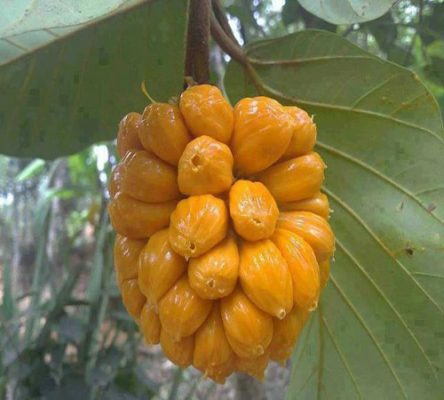
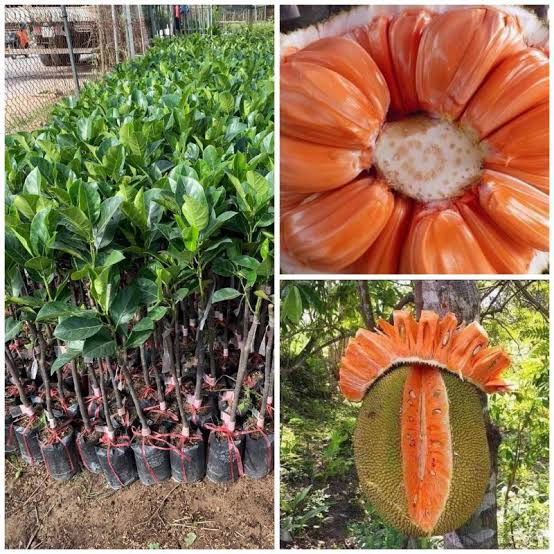
While Dong Nai features high-yielding varieties like Viên Linh, Thai jackfruit, Artocarpus heterophyllus (mít nghệ), and Cempedak (mít tố nữ), farmers are encouraged to select proven local varieties like mít nghệ (awarded in fruit competitions) for their exceptional quality, consumer preference, and suitability for processing, drying, and export packaging.
 Zalo
Zalo